The short version: Manny Khoshbin slept in a 1972 Datsun at 14, bought his first house in 1996 with $1,300 out of pocket, and now holds a couple hundred million in commercial real estate. He looks at about 20 properties a day, writes one offer every three or four months, and had nothing in escrow for the 18 months before we talked. He made all his money in recessions. The lesson: start small, swing a lot, and wait for the cycle.
Updated September 2026. Originally published June 2023.
Manny Khoshbin looks at 900 properties to write one offer.
About 20 a day come through his lead flow. Every three or four months, one is worth an offer. When I sat down with him in his office in Southern California he had not gotten anything into escrow in 18 months. This is a guy who has bought 70, 80, maybe 100 properties, spent over a billion dollars doing it, and owns $30 million in cars.
Want the one email I send when I have something worth sending?
114,000+ entrepreneurs get it. One story from my business, one tactic you can use. No schedule, no fluff.
“On a good day I look at probably 20 properties, not physically, but on my lead flow. And I probably write an offer every three, four months. That’s 150 deals a month. In six months, that’s 900 properties I look at. And then I make one offer. And I haven’t been able to get anything in escrow for the past 18 months.”
I run AppSumo and it does well, and I do not think of myself as a risky person. I can’t imagine losing my money. I am also impatient. I want this, I want that, I want it now. So the guy who lost everything twice before he was 30 and then made a couple hundred million by waiting was the guy I wanted to talk to.
Bananas and a Datsun
Two weeks before his 14th birthday, Manny’s dad decided to leave Iran. The war with Iraq was on, one of his uncles had died from chemical bombs, and at 14 a boy can’t leave the country because he’s headed for the army. Four kids, the youngest six months old, a few thousand dollars, a Motel 6 in Costa Mesa. After a few nights his dad did the math and moved the family into the car.
“It was a 1972 Datsun station wagon. A lot of cold nights. It wasn’t good.”
Six people. Bananas for dinner, because bananas were the cheapest thing.
By 20 he had $20,000 saved from selling nuts door to door at car dealerships, put it into a gas station, and lost all of it to a con artist loan officer. At 22 he opened a mortgage company and made $290,000 the first year. Mercedes 500 SEL, condo, three piece suits. Then Greenspan raised rates in 1994, and every one of the 40 unlocked loans on his board died. He put his savings into a discount store in Santa Ana, 79 Cents Plus, and two years later he owed over $200,000 on credit cards at 20% interest.
“It’s one thing not having money and not making it. But once you make it, and then you go back to zero, it’s a hard landing.”
Everyone told him to file bankruptcy. He said no, this country is built on credit, if I file I’m dead. He let the employees go and brought his parents in as cashiers. Two and a half years to positive cash flow, then he sold the store for $485,000 and still owed more than escrow paid him.
Too good to be true, twice
The landlord he was bouncing rent checks to at that store was a man named Mr. Williams, who owned a few hundred million dollars of real estate and had watched Manny work seven days a week, 14 and 15 hour days, to pay him.
“He told me, look, you remind me of me when I was young, when I came to Orange County. When you sell the store or you close it or whatever you do, come see me. You should get into real estate.”
First, though, Manny put what was left into an E*Trade account in December 1998. By September 1999 it was $700,000, on AOL, CMGI and Brocade. He pulled most of it out. His friends called him an idiot. More than triple in nine months was too good to be true, he said, so he left $80,000 in and called Mr. Williams, who sent over his broker.
He did the same thing in 2007. By then he’d gone from one vacant building on 1st Street in Santa Ana, bought for $675,000 and sold for $1.6 million in under a year, to over $100 million of real estate and 2 million square feet, mostly in Houston. People from Florida and New York were bidding on his $18 million high rise without seeing it.
“This is not normal. It’s just too good to be true.”
He sold the whole portfolio. Most of those high rises went back to the bank in the recession, and three years later he bought five of them from the bank and sold them again.
That is where the 900 to one number comes from. His money gets made in the down years, so the up years are for looking, and looking is most of the job. Last recession he only owned one Bugatti, because everything else was going into buildings.
Calculated risk
The other half of his patience is what he does when the one offer is ready. He moves faster than anyone. In the early days he wrote offers on Long Beach apartment buildings with quick closes and no contingencies.
“If they’re asking 900 grand and I offer them 650, they settle for 700. I just made $200,000. Because I was able to perform quick.”
Same move at his current size. He bought a building for $22 million with a $1.5 million non refundable deposit on day one. There was a $26 million offer on the table, but those buyers wanted 90 days of due diligence and the seller wanted certainty. When we talked he was opening escrow to sell it for $72 million to a developer putting 400 to 600 apartments on the dirt.
He draws a hard line between that and gambling. Buying a coin because you think it’ll go up is speculating. Buying a mismanaged property you’ve analyzed and know could be worth double once it’s leased is a calculated risk with a known upside. He’s still wrong sometimes. A Boeing subsidiary in one of his buildings lost its NASA contract and a one page FedEx letter cost him $5 million in cash. A 12 story Houston tower he bought betting everyone would go back to the office is sitting mostly empty. Now he won’t touch anything over three stories.
“Fear and panic always creates opportunity, whether it’s real estate, cars or stocks. As you take risks and be a contrarian and you make money with it, your balls get bigger.”
Bigger upside costs you more uncertainty. Every one of my richest friends told me some version of that.
Start with the $1,300 house
The part I don’t want you to skip is how small he started. His first house, 1996: an FHA loan, 3% down, and since he had a real estate license he used his own commission for the down payment. $1,300 out of pocket for closing costs on a bank owned home in Garden Grove. Sold a year later for $80,000 more. The Santa Ana building that made his first million was $67,000 out of pocket, 10% down on an SBA loan he qualified for because he’d owned the store.
People want to jump from zero to the million dollar deal. Manny’s version is the $100,000 house, then the next one. And the waiting only works if you’ve already started, which is the part I keep having to relearn and the reason I wrote Million Dollar Weekend.
“If you don’t start and you’re just always waiting for a better deal, you could be my age, 52, and you don’t have nothing. But if you started 30 years ago like me, with that first house with 1,300 bucks, hey, you’re on top of the mountain, you’re getting there.”
Six people in a Datsun eating bananas, then a $1,300 house, then 900 properties for every offer.
Buy the small one. Then look at the next 20.
From episode 306 of my podcast, Noah Kagan Presents. Listen on Spotify or Apple Podcasts.
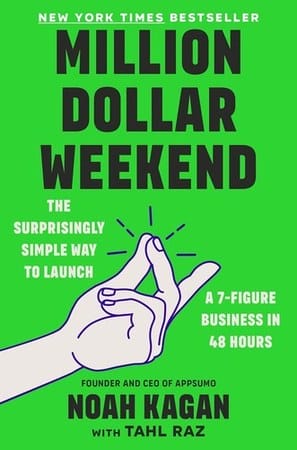
Start a business in 48 hours.
Million Dollar Weekend is the process I used for eight businesses, written down. #1 on Amazon and Audible.
Read the first chapter free
Leave a Reply