The short version: David Lee runs Hing Wa Lee Jewelers in Los Angeles, a business his father started in Hong Kong in 1965 after swimming out of China at 13. David took it from wholesale to retail in 1993 working seven days a week, got the Rolex dealership in 1995, grew the business about 100 times, and owns around 30 Ferraris worth roughly $80 million. His formula is five things: work hard, persevere, keep your integrity, plus timing and opportunity. His one regret is working so hard he missed his kids growing up.
Updated September 2026. Originally published September 2023.
David Lee owns about 30 Ferraris. They are worth around $80 million. He keeps it at 30 so he can drive each one about once a month, because the classic ones break down if you don’t.
I asked him how he made his first million. Seven days a week for years, opening and closing the store himself.
Want the one email I send when I have something worth sending?
114,000+ entrepreneurs get it. One story from my business, one tactic you can use. No schedule, no fluff.
I asked him if it was worth it. “I regret it.”
I found David on Instagram years ago because he has the biggest Ferrari collection in the world. Turns out he also runs one of the biggest Rolex dealers in the world, Hing Wa Lee Jewelers in LA, and his family has a story that should be a movie. I walked in wondering how many Ferraris one person needs. I walked out thinking about the recitals.
Two volleyballs and a sack of bread
David’s father was born in southern China. His grandfather was the village leader and had some education, so the Red Army took him to a camp to be reprogrammed. A lot of people died in those camps. The family had no breadwinner.
His father was 13. His older brother was 15. They stowed away in the hold of a supply boat going from China to Macau with 20 or 30 other people, and at the closest point they jumped off and swam for shore, still miles away.
“They did it by a flotation device, which is two volleyballs and a net, and a sack of bread to make the journey.”
People died from the cold, from the waves, from getting tired and going under. If you got close to Hong Kong the coast guard would beat you and send you back to China, where the authorities beat you again. He made it. With no skills, the only job was apprenticing to a master. His uncle went to a tailor. His father went to a gemstone carver. “He didn’t say, oh, I want to be a gemstone carver. That was the destiny of him.” Five years living frugally and sending money back so the whole family could eat, then in 1965 he started his own business. That is Hing Wa Lee. It turns 60 in two years.
The family got to America because the Smithsonian needed someone to restore a collection of delicate Chinese art. The team they sent to Hong Kong interviewed ten gemstone masters and kept going back to David’s father.
The five things
People ask David for the business ethics of success. He pulled everything his father taught him into five things. Three you control: work hard, work hard with perseverance, and work with integrity. Two you don’t: timing and opportunity.
“If all five of these things are right at the same time, and you take action at that time, that will produce success. Sometimes you’re doing all these work ethics, you have the opportunity, but the timing is not right. Sometimes the timing is right, the opportunity is right, but you didn’t do those things. All five have to come together.”
And it is slow. “You might have to do all three things, and it might be ten years later. It could be 15 years. It could be 20 years later, and then it all comes together. Nobody says it’s gonna come quick.”
The first million is what the three you control look like at full volume. In 1991 there was a bad real estate recession. David told his father they should move the business from wholesale to retail. His father said, “Okay, I’ll trust you. But you have to be in charge.” They had never done retail. In 1993 he opened the store in San Gabriel.
“I had to be the sales manager, the personnel manager, the accounting manager, the marketing manager. I had to be the first person to open the store and the last one to leave. I had to work seven days a week. There’s no, I’ll have a day off, because who’s gonna open and close?”
That was the first few years. “When I was talking about working hard, that’s the level I’m talking about.” Persistence got him the Rolex dealership in 1995, which changed the course of the business. Integrity kept it. There was a lot of temptation to buy gray market Rolexes. “If I did that, I would be blackballed. I would never get the Rolex authorized dealership. That was a shortcut to make money, but I could not do that.” The first million came shortly after. From the day he took over to now he has grown the business about 100 times. (Whenever I ask my richest friends how they made their first million, the answer looks a lot more like this than like the cars.)
The regret
David is in his 50s and mentors a group of younger business people. They’re newly married or have young kids, and they ask him the question I asked.
“I tell them, listen, I regret it. I regret working so hard that I missed a lot of the time with my kids when they were young.”
He gave his family the best house, the best schools, the best vacations. “But if you ask the kids, they would say, hey, I would rather have seen my dad come to my performance, come to my recitals, come see my ball games.” Then he said the part I didn’t expect from a guy who preaches seven days a week.
“Sometimes that’s really selfish, because that’s what we want to do. We don’t want to deal with the home and the kids and their troubles and our wives. We actually want to escape that and be in this workplace where we have full control. This is our domain. So it’s actually harder and more selfless to balance and take off some of that time to be with your family.”
Nobody told him that. He’s telling his mentees so they don’t find out at 50. It is the same answer I kept getting when I went asking 80-year-old millionaires if it was worth it.
So I asked him straight whether he has too much money. My brother’s take is that CEOs shouldn’t make this much. Pranav, who I work with at AppSumo, said “well, it’s an investment.” David’s father passed away 12 years ago and his father-in-law just passed. Both wealthy men. “When he came into the earth and when he left the earth, he didn’t bring anything with him. Not one thing. So we really don’t own these things. We’re just stewards of this wealth.” The car behind us during the interview was his latest purchase, and he loves his 296 GTB. But: “Purchases, material things, are great, but they’re temporary enjoyment. They’re temporary satisfaction. They’re not an eternal satisfaction.” He sits on the board of Door of Hope, which takes in homeless families and gets them into a job and an apartment within six months, and says that gives him more joy than buying stuff.
The blue Phantom
His father was frugal with himself to the end. He put the money into apartment buildings he would never use, for the generations after him. “They don’t speak it, they don’t say it, but the actions they do shows the love.”
In Hong Kong his father would cross Victoria Harbour on the Star Ferry, walk down Salisbury Road past the Peninsula Hotel, and into his little office. The Peninsula had a whole fleet of Rolls-Royces out front. In his mind a Rolls-Royce meant you had made it. He talked about it for years and never bought one, because that much money could be the down payment on another apartment building for the family.
So in 2005 David bought a blue Rolls-Royce Phantom from a dealer in Pasadena and gave it to him.
“If he was to buy it himself, he would be guilty. But his son bought it, so he’s actually happy. Now he can brag to his friends: not only could I afford a Rolls-Royce, I helped my son be successful enough to buy one and give it to me.”
He barely drove it. David still has it in the collection.
The five things get you the Ferraris. They do not get you back to the ball game you skipped. Go to the next one.
From episode 317 of my podcast, Noah Kagan Presents. Listen on Spotify or Apple Podcasts.
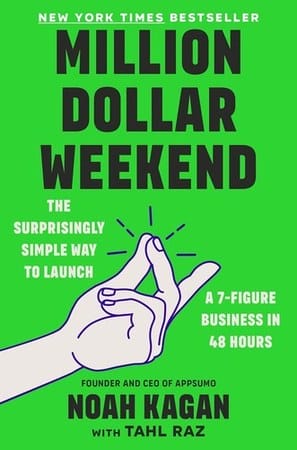
Start a business in 48 hours.
Million Dollar Weekend is the process I used for eight businesses, written down. #1 on Amazon and Audible.
Read the first chapter free
One response to “The $80 million Ferrari collector regrets working so hard”
I have a Ferrari rear wing that was given to my by the driver after he crashed his car it’s in great shape. Has a crack on the back side of the wing. Need money for my mothers cancer treatment and I am looking to sell is. I am 13 years old and want to help my mom.