The short version: Andrew Viterbi came to America at 4 as a Jewish refugee from Fascist Italy, made 65 cents an hour as a soda jerk, invented the Viterbi algorithm while trying to teach a hard class at UCLA, sold his first company for $25 million and cofounded Qualcomm, now worth about $120 billion. He says almost all of it was luck, “but you have to seize your luck.” The worst money he ever lost was betting on the wrong people.
Updated September 2026. Originally published April 2023.
Andrew Viterbi’s chips are in the phone you are holding. He cofounded Qualcomm, a $120 billion company, and created the algorithm that made 2G and 3G work. When I read him the valuation he said, “OK, but it’s not a trillion yet.”
He is in his 80s. He is a billionaire. And for 30 minutes he refused to take credit for any of it.
Want the one email I send when I have something worth sending?
114,000+ entrepreneurs get it. One story from my business, one tactic you can use. No schedule, no fluff.
“I was in the right place at the right time. We migrated to cellular phones, which are the fastest growing industry in history. A lot of that was luck, but you have to seize your luck.”
He kept saying luck. So I went looking for the seizing.
The first luck was a visa
In 1938 his father was head of a department at a large public hospital in Italy, at the peak of his career, and got fired for being a Jew. Italy entered the war in 1940 as an ally of Nazi Germany. Jews could not work, kids could not go to school, teachers from kindergarten to grad school were kicked out. Nobody was killed until 1943, when the Germans came down and started rounding people up. About 20 percent went to the camps. 99 percent of those died.
I asked how his life would have gone if the family had stayed.
“Oh, I would have wound up in the ashes. We might have made it to Switzerland, but had we not, I would have wound up as an eight-year-old bunch of ashes. Does that drive me? Well, to some degree.”
His parents tried for an American visa when the State Department was refusing them to Jews. Ken Burns has a full hour on it. “But my father found the way and we made it here. He had some luck. That was the first luck.” The second luck was his father, a physician, passing every medical exam over again to get licensed, and doing it in Boston instead of New York. He would have earned more in New York. Andrew got a better education in Boston. He figures his own luck was “divine retribution for my father’s bad luck.”
By 10 he had decided he was going to MIT. He did.
65 cents an hour, then a class he couldn’t teach
First job: soda jerk at a drugstore in downtown Boston, 65 cents an hour. “Of course I’ll remember.” Then a co-op student at MIT for about $80 a week, “which seemed like a lot of money to me then. And it was.” Then $700 a month at Caltech’s Jet Propulsion Laboratory. He had three offers, all government contractors. The other two were for profit. He picked JPL because it had more technology, more science and more potential. “Boy was I right. But pure luck.” Three months after he got to Pasadena the Russians “were nice enough to launch Sputnik,” and he was in the space race.
The algorithm that carries his name did not come out of a lab.
“I was teaching a course at UCLA. And the course involved some very recent research that had come out of MIT. And it was very hard to teach it because it was very complicated. And I found a simpler way to describe it. And I wasn’t so sure that it would be commercially useful.”
The Navy used it first, then the Air Force, then the Army, and NASA at the same time. NASA describes it as doubling your range: a satellite you could reach at 1,000 miles up, you can now reach at 2,000. Commercially it started by quadrupling the number of phones you could put on a piece of spectrum, and spectrum was very expensive. That made his first company, Linkabit, which he started in 1969 with Irwin Jacobs, profitable and “worthy of being bought.” They sold it to a small conglomerate for $25 million, “which proceeded to ruin it.” So they left and started Qualcomm.
The seizing at Qualcomm looked like this. His engineers came to him and said the spread spectrum work they were doing for satellites could work on the ground too. “At first I told them they were crazy, but they proved otherwise. And the company really took off.” The highlight of his career was Motorola, AT&T and Verizon voting for Qualcomm’s standard over the European one. “It didn’t happen all at once, but gradually it really spelled the success of Qualcomm.”
I asked what percent of Qualcomm he owned. Bigger at the start, a lot less by the IPO. “That was never my concern.” What was? “I had a good time. I got a very big kick out of all the technological successes and then finally the commercial success.”
What the billion changed
“It didn’t change my lifestyle. Some things I still think the way I used to when I was an assistant professor. Not a starving one.”
He built a ranch in Rancho Santa Fe. He had a Ferrari for a while because his kids talked him into it when he retired at 65. They made a down payment. He told them no, he would pay. “But I didn’t like it. The best car I’ve driven is the Tesla.” He notices inflation and feels guilty about it. “People are hurting. And I’m not splurging, but I’m not hurt by it.” So most of it went to philanthropy: the school of engineering at USC, a department at the Technion in Haifa, half a dozen endowed chairs at MIT plus scholarships. “I’m kind of a sucker for supporting academia, especially supporting students in need. Because I was one as a freshman at MIT.” Same idea as my Die With Zero review. The money is for something.
Does he regret working that hard? He quoted the French song. “Je ne regrette rien. I don’t regret anything.” He traveled more than a full-time job in the 90s, but his kids were in college by then and his wife came with him. “I never hesitated to pick up the phone no matter what I was doing. And I’m proud of that.” He has five grandchildren, “the sunlight in my life,” and went to three of their weddings this summer. When I went asking 80-year-old millionaires if it was worth it, his was the shortest answer I got.
The worst money he ever lost
After Qualcomm he ran a venture fund. I asked about the sillier or worse things he spent money on.
“The worst was when I had invested, it happened more than once, in people. Engineers who had started companies, engineers who had worked for me at Qualcomm. And I believe that the success of a startup depends, if not exclusively, primarily on the people they have. And not only technology, also the business side.”
One of those companies had IBM as an early customer. “They screwed up. And that was a big disappointment. And I lost a couple of million.” Others he got lucky on and made 10x or more.
People is his one thing for startups, and it was the hardest part of Linkabit. “Who’s going to join five academics?” By Qualcomm they had a reputation, and the good ones came from MIT, the California schools, UCSD, San Diego State.
He would not even take credit for the algorithm. He was one of 10,000 creators, he said, and quoted Paul Baran, an entrepreneur in the Bay Area: a major discovery requires building a large brick wall, and every participant brings a brick. “And my brick was successful.” He wrote a memoir, but the thing he wants to be remembered for is “being the head of my family and having both successful grandchildren and children and also a warm family.”
So I pushed on luck one last time. How does a person get more of it?
“The old adage is you make your own luck. You got to participate. Or the luck may be there, but you won’t get it. You have to really work at it. That’s life.”
65 cents an hour, then $80 a week, then $700 a month, then Qualcomm. He calls all of it luck. He also took the lower-paying job, taught the class nobody could teach, and listened to the engineers he thought were crazy. The luck was there. Go participate.
From episode 296 of my podcast, Noah Kagan Presents. Listen on Spotify or Apple Podcasts.
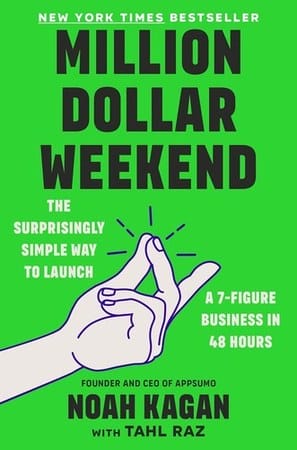
Start a business in 48 hours.
Million Dollar Weekend is the process I used for eight businesses, written down. #1 on Amazon and Audible.
Read the first chapter free
Leave a Reply