The fastest way to get your first customer is to sell to someone who already trusts you. Make three lists (contacts, communities you’re in, anyone who has paid you before), pick the ten most likely buyers, and ask each one directly with a price and a deadline. Deliver the work by hand. Repeat until you have three paying customers.
Your first customer is not a stranger.
Everyone pictures the first sale as some heroic cold pitch to a person who’s never heard of them. That’s the hardest possible version. Your first customer is almost always someone who already knows your name, already trusts you a little, and already has the problem you’re solving. You just haven’t asked them yet.
Want the one email I send when I have something worth sending?
114,000+ entrepreneurs get it. One story from my business, one tactic you can use. No schedule, no fluff.
Here’s how to find that person and close them this week.
Start in your Zone of Influence
Your Zone of Influence is everyone who already trusts you enough to take your call.
Former coworkers. College friends. The guy you play basketball with. Your dentist. The Slack community you lurk in. Your cousin who runs a landscaping company. Every one of those people will read a text from you. Almost none of them will read a cold email from a stranger.
That’s a massive, unfair advantage, and most first-time founders throw it away because selling to people they know feels awkward. It’s not awkward. It’s a favor. You’re solving a problem for someone who trusts you, at a fair price, and you’re going to work harder for them than any agency ever would.
Customers don’t care about your ideas. They care about whether you can solve their problems. Start with the people whose problems you already know.
The three lists
Open a doc. Make three lists. Do not skip this because it feels basic. It’s the entire foundation.
List 1: Contacts
Scroll your phone. Scroll your email. Scroll LinkedIn. Write down every person who could plausibly have the problem you solve, or who knows people who do. Aim for 50 names. You’ll get there faster than you think.
List 2: Communities
Every group you’re already a member of. Facebook groups, Discords, Slack workspaces, subreddits, your church, your gym, the parents’ group chat, an alumni network, a trade association. Ten to twenty of them. These are places where you can post and people know you’re not a spammer.
List 3: Past customers
Anyone who has ever paid you for anything. Freelance gigs, a side hustle in college, that time you sold your old bike. If you’ve never been paid for anything, anyone you’ve ever done a favor for that they thanked you for. These people have already said yes to you once.
Now go through all three and star the ten most likely to buy. Most likely means: they have the problem, they have money, and they’d pick up if you called.
Those ten are your first ten conversations. The book calls this list your Dream Ten.
The exact ask
Here’s where most people lose. They send a vague, hopeful message and then wait.
“Hey, I’m starting a thing, let me know if you or anyone you know might be interested!”
That’s not an ask. That’s a hint. Nobody responds to hints.
An ask has four parts: the problem, the solution, the price, and a direct question.
Script for someone you know:
“Hey [name]. You mentioned [problem] a while back. I’m now doing [solution] for [type of person]. It’s $[price] and I’ll have it done by [date]. Want me to do yours first?”
Script for a community post:
“I’m taking on 3 [type of people] this month who are dealing with [problem]. I’ll [specific outcome] for $[price], done in [timeframe]. Comment or DM me if you want one of the spots.”
Script for a past customer:
“You paid me for [old thing] before and it went well. I’ve started [new thing]. $[price], and I’d love for you to be one of my first. Can I send you the link?”
Then stop typing. State your ask and shut up.
Notice: a specific problem, a real number, a deadline, a yes-or-no question. If it makes you nervous, that’s how you know it’s an ask and not a hint. Go do the Dollar Challenge first if the nerves are winning.
Do the service manually first
You’re going to want to build something before you sell. A website, an app, a course platform, an automated funnel.
Don’t.
If you want to start a SaaS business, do the service before you make the software. Then create software to do that service. Same rule for everything else. If you want to sell a course, coach three people live first. If you want to sell meal plans, write three by hand in a Google Doc. If you want to build a booking app, book the appointments yourself over text.
Doing it manually does three things. It gets you paid this week instead of next quarter. It shows you what customers actually want, which is never what you assumed. And it makes the eventual product ten times better, because you built it from real orders instead of imagined ones.
I don’t start businesses until I know they’re already working. Manual delivery is how you know.
The 10 conversations rule
Before you decide anything about your idea, have ten real conversations where you ask for the sale.
Not ten posts. Not ten emails into the void. Ten actual back-and-forth conversations with a human where you describe the offer, name the price, and ask them to buy.
Ten is the number because it’s enough to see a pattern and small enough to finish in a weekend. After ten, one of three things is true:
- Three or more said yes. You have a business. Go deliver.
- One or two said yes. Something’s close. Look at what the yeses had in common and go find more of those people.
- Zero said yes. The offer, the price, or the customer is wrong. The nos will tell you which.
Most people quit after two conversations. Two nos, “this doesn’t work,” back to the day job. Two is nothing. Ten is data.
Here’s the process in order:
- Pick your ten from the three lists. Most likely buyers first.
- Send the ask to all ten today. Text, DM, or phone. Not email. Email is where asks go to die.
- Follow up with every non-reply after 48 hours. “Bumping this. Yes or no is totally fine.”
- Ask every no for a referral. “No worries. Who do you know who deals with this?” Add the name to List 1.
- Send a payment link the moment someone says yes. Not “I’ll send an invoice next week.” Now. Yes decays fast.
- Deliver by hand, fast, and over-deliver. First customers are your case studies and your referral engine.
- Ask each paying customer for two more names. Now you’re at conversation eleven through sixteen without a single cold pitch.
No ask, no get.
Pricing the first deal
You’ll be tempted to do the first one free. Sometimes that’s right. Usually it isn’t.
Here’s my rule. If you have zero customers and zero proof, working free for a short stretch can get you off the sidelines. Do it for free until you’re too busy, then say “I’m too busy, so you’ll have to pay now.” That’s a real strategy and it works, especially when you’re in a slump.
But the moment you have one person willing to pay, charge. A paying customer behaves differently. They show up. They give feedback. They refer people. A free customer ghosts you and you learn nothing.
How to pick the number:
- Look at what they’re already paying for a worse version. An agency, a tool, a freelancer, their own wasted time. Price under that.
- Charge enough that you’ll actually do the work well. If $50 makes you resent the job, it’s the wrong price.
- Offer a “first customer” price and say so. “First 3 customers get it for $300, then it’s $500.” Urgency plus a reason for the discount. Nobody feels cheated.
- Get paid upfront. Or at least half. Everyone’s interested until they have to pay. Payment is the validation.
Don’t agonize. Pick a number, say it out loud, and adjust after the third customer.
A real example
A reader named Hanny Tran wrote up her first weekend running this playbook. She pitched her idea directly to seven people in her network. Four said no (nicely). Three paid. Three customers from seven conversations, all people who already knew her. Then she looked at the idea honestly, decided it wasn’t in her zone of expertise, and dropped it to find a better one.
Seven conversations. Three customers. A clear decision. In two days. (Hanny Tran, “Million Dollar Weekend: How Noah Kagan Made Me Rich(er) and Brave(r)”, cheershanny.medium.com/million-dollar-weekend-how-noah-kagan-made-me-rich-er-and-brave-r-20cfe770f0d1)
That’s what the three lists and the direct ask look like in the wild. Nobody built a website. Nobody ran an ad.
My own first businesses ran the same way: people I already knew, asked directly, paid before anything existed.
When I pre-sold a monthly jerky subscription in 24 hours (a dare from my Monthly1K students, and I wasn’t allowed to touch the AppSumo list), I worked the three lists. Contacts: health-conscious friends got a 2 a.m. email. Monthly jerky service, $40 a month, three months for $120 or six for $240, limiting it to 20-ish people, PayPal me. With a PS: “know any offices who buy snacks I should chat up?” Communities: friends at startups who could buy for their team or intro me to their office manager. Past customers, in reverse: the service providers I was already paying who worked in offices, because it’s easiest to ask for money from people you give money to. The offices were the jackpot. One company took a twelve-month package. End of day: $4,040 in revenue, $1,135 in profit, and every sale came from a person who could already place my name.
When I launched the first AppSumo deal in 2010, same thing at a bigger scale. I didn’t know the founder of Imgur, but I emailed him with something in it for him (we’ll sell 200+ copies of Imgur Pro for you, at no cost or work on your end). I didn’t know Reddit’s founding engineer either, but I asked him to breakfast and asked for free ads. Both said yes. Then a single web page with a PayPal button, $50 and 48 hours to build, took its first sale within minutes and hit the 200-license goal.
Watch it
Five business ideas from subscribers, and I go get a first customer for each one on camera: LinkedIn first connections, your current service providers, old coworkers, a text that starts “wild question.”
When to stop and change the idea
This is the part nobody wants to hear, so I’ll be blunt.
If you have had ten real conversations, asked for money in every one, and nobody paid, change the idea.
Not “tweak the landing page.” Not “try a new logo.” Change something big: the customer, the problem, or the offer. You’ve spent a weekend and learned it doesn’t work. That’s cheap. Spending six more months hoping is expensive.
Signals that it’s time to stop:
- Ten asks, zero payments, and the nos all say the same thing.
- People say “cool idea” and then vanish when you send the link. That’s the Mom Response. Interest without payment is a no.
- You can’t name a single person who has this problem badly enough to pay this week.
- You find yourself building instead of asking, because asking keeps going badly. That’s the Engineering Disease. It feels productive. It isn’t.
Signals to keep going:
- One or two paid and the others said “not right now” instead of “no.”
- The nos are about price or timing, not about the problem.
- People keep referring you to someone else. The market exists, you’re just talking to the wrong slice.
Every business has been done. Think about it as a practice, an experiment. You’re just getting a rep in. If this rep didn’t land, the next idea is sitting in the nos you just collected. Read them again. Then go validate the next one in 48 hours.
And if you’re stuck on “I don’t even have an idea,” go pull one from business ideas you can start this weekend and come right back here.
FAQ
How do I get my first customer with no audience?
You don’t need an audience. You need your Zone of Influence: the people who already know you. Make three lists (contacts, communities you’re in, anyone who has paid you before), pick the ten most likely buyers, and ask each one directly with a price and a deadline. Your first customer is almost always someone you already know.
How many people should I ask before giving up on an idea?
Ten real conversations where you ask for the sale with a price. If three or more pay, you have a business. If zero pay after ten, change the customer, the problem, or the offer, not the logo. Ten is enough to see a pattern and small enough to do in a weekend.
Should I give my first customer the product for free?
Only if nobody will pay yet and you need to get off the sidelines. Work free until you’re too busy, then start charging. But if even one person is willing to pay, charge them. Paying customers show up, give real feedback, and refer people. Free customers usually ghost.
Get the first chapter of Million Dollar Weekend free
Chapter 1 is the Dollar Challenge, NOW Not How, and your Freedom Number. The Zone of Influence, the Dream Ten, and the preselling scripts are in Chapters 3 and 5.
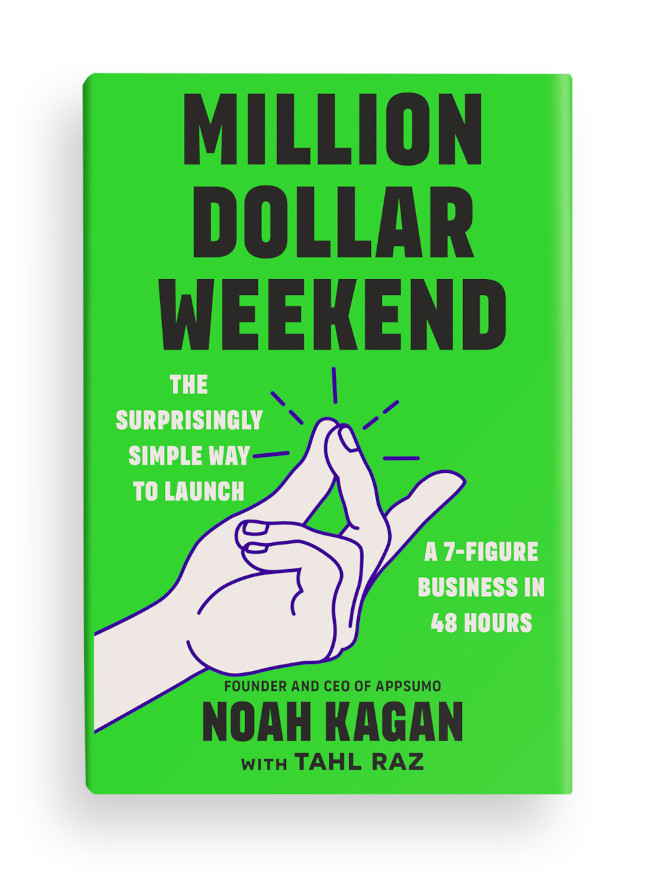
Or grab the whole thing: Million Dollar Weekend
Open your contacts. Send the first ask before you close this tab.
Start a business in 48 hours.
Million Dollar Weekend is the process I used for eight businesses, written down. #1 on Amazon and Audible.
Read the first chapter free
Leave a Reply