The fastest way to validate a business idea is to get three people to pay you for it within 48 hours, before you build anything. Skip surveys and “would you buy this” questions. Ask for money directly: a pre-sale, a marketplace listing, or a landing page with a payment button. Three paying customers means go. Zero means change the idea.
Everyone’s interested until they have to pay.
I have watched thousands of people “validate” ideas with spreadsheets, surveys, and pitch decks. Almost none of them made a dollar. The ones who did skipped all of that and asked someone for money on day one.
Want the one email I send when I have something worth sending?
114,000+ entrepreneurs get it. One story from my business, one tactic you can use. No schedule, no fluff.
That’s the whole method. Here’s how to run it.
Why “would you buy this?” fails (the Mom Response)
Ask your mom if she’d buy your product. She’ll say yes. She loves you.
Ask your friend. He’ll say “cool idea, man.” He wants you to like him.
Ask a stranger on a survey. She’ll click “very likely” because it costs nothing and she’s already thinking about lunch.
I call this the Mom Response. Hypothetical questions get hypothetical answers. Nobody wants to be the person who crushes your dream over coffee, so they hedge, they smile, they say “yeah, probably.” And you walk away with false confidence and six months of building ahead of you.
Never ask people if they would buy. It’s not the same thing as buying.
The only validation that counts is money leaving someone’s account and landing in yours. Not a like. Not a waitlist signup. Not “send me the link when it’s ready.” Money.
I don’t start businesses until I know they’re already working. That’s not caution. That’s just asking for the sale before writing a single line of code.
The 48-Hour Validation Rule
Here’s the rule I use for every idea, and the one I make people use in every workshop:
Find three paying customers in 48 hours, or move on.
The book calls this the Golden Rule of Validation. Three, not one. Your first customer is a friend doing you a favor. Your second is family. Your third is hard, and that’s the one that tells you the truth: a separate person who decided your thing is worth their cash.
48 hours, not three months. The time limit is the point. Limitations create the best creativity. When you have a weekend instead of a quarter, you stop designing the logo and start texting people.
If you hit three, you have a business. Not a big one yet. But a real one, with real customers, and now the question is “how do I get 30?” instead of “does anyone want this?”
If you get zero after 48 hours of actually asking (not “thinking about asking”), that’s information. Cheap information. You spent a weekend and learned something that would have cost most people a year and their savings.
Fail quick, iterate fast.
The One-Minute Business Model
Before you ask anyone for money, spend one minute making sure the math can work. Not a business plan. One minute.
Three questions:
- How big is the market? Are there at least a million people (or a lot of businesses) who have this problem? Google it. Check how many people search for it, how many competitors exist, how big the Reddit community is. Competitors are good. Competitors mean customers exist.
- What can I charge? Pick a price. A real number. $50? $500? $20 a month? Look at what similar things cost.
- How many customers do I need? Revenue minus cost is profit. Take the profit you want (the book uses $1 million; say $100,000 a year to start) and divide by the profit per sale. At $500 profit per customer, that’s 200 customers. At $20 a month, that’s about 417 customers. Can you picture getting that many? Do they exist? Can you reach them? If not, turn a revenue dial: raise the price, sell a subscription, or sell to businesses.
If the answer to any of these is “no” or “I have no idea,” change the idea or change the price. Don’t spend a weekend validating something that can’t pay you even if it works.
Example: You want to sell a $10 ebook and make $100,000. That’s 10,000 buyers. Do you have a way to reach 10,000 people? Probably not this weekend. Now try a $500 consulting package. That’s 200 customers. Or one a week for four years. Much closer to real.
One minute. Then go ask.
The Customer First Approach
Most people start with an idea and go hunting for customers. Flip it.
Start with a customer you can already reach, and find the problem they’ll pay to solve.
Who do you already know? Who already trusts you? What group are you already part of? Dentists, dog owners, Shopify store owners, your old coworkers, the parents at your kid’s school. That’s your starting market, not because it’s the biggest, but because you can get on the phone with them today.
Then ask them what’s annoying. What did they pay for last month? What did they Google and not find? What did they complain about at dinner?
Customers don’t care about your ideas. They care about whether you can solve their problems.
Solving a problem for people who already know you is the cheapest validation on earth. You skip the “who is this weirdo” phase entirely.
Three ways to get paid before you build
You do not need a product to get paid. You need a promise and a way to collect money. Here are the three I use.
1. Direct pre-sale
Call, text, or DM someone. Describe the thing. Ask for the money. This is the fastest and it works for services, physical products, courses, software, anything.
You send them a payment link (Stripe, PayPal, Venmo, whatever). They pay. Now you go make it.
Yes, before it exists. You tell them the truth: “I’m launching this, you’re one of the first, here’s when you get it.” People buy pre-orders all the time. Kickstarter is a multi-billion dollar company built on this exact idea.
2. Marketplace listing
List the thing where buyers already are. Etsy, Amazon, eBay, Fiverr, Upwork, Gumroad, Facebook Marketplace, a local Craigslist.
You don’t build traffic. You borrow it. Someone else already spent a fortune getting buyers to that site. Put your offer in front of them and see if anyone bites.
3. Landing page with a payment button
One page. Headline that names the problem, three bullets, a price, a Buy button. Carrd or a Notion page works. Then drive 50 to 100 people to it: your email contacts, a post in a relevant community, a small ad budget if you must.
The difference between this and a “waitlist” is the button says Buy, not Notify Me. Waitlists collect maybes. Payment buttons collect customers.
Pick one method. Two if you’re feeling spicy. Do not spend Saturday debating which.
The 48-hour process, step by step
Here’s the exact sequence. Print it, tape it to the wall.
- Friday night: pick one idea. One. Run the One-Minute Business Model on it. Write down the price.
- Write your list of 10 people. Names you can reach today who plausibly have this problem. Use the Customer First Approach: start with who you already know.
- Set up payment in 10 minutes. A Stripe or PayPal link, a Venmo handle, a Gumroad product. Ugly is fine.
- Saturday morning: ask the first 5. Use the scripts below. Phone or DM, not email. Email lets people hide.
- Ask for a referral from every no. “Who do you know that deals with this?” Add them to the list.
- Saturday afternoon: post in one community or list on one marketplace. Second channel, same offer.
- Sunday: ask the remaining 5 and follow up with anyone who said “maybe.” Maybe is a no that hasn’t finished yet. Push for a decision.
- Sunday night: count the money. Three or more paid? Go. Zero? Change something (price, customer, problem) and run it again next weekend.
Notice what’s not on the list. No logo. No LLC. No website beyond a payment link. No “market research.” Just asking.
Scripts to ask for money
Asking is the part everyone skips, so here are words you can steal.
The direct pre-sale (text or DM):
“Hey [name], I’m starting a [thing] for [type of person] that solves [problem]. I’m taking the first 5 customers at $[price] before I open it up. Want in? I can send you a link now.”
The problem-first ask (for someone who has complained to you):
“You mentioned [problem] last week. I’m going to fix that for people. $[price] and I’ll have it handled by [date]. Want me to do yours first?”
When they say “sounds great, send me info”:
“Here’s the payment link. First 5 spots only. If you’re in, grab one today and I’ll start on yours tomorrow.”
When they say “let me think about it”:
“Totally fine. What would make it a yes?”
Then shut up. State your ask and shut up. Silence is uncomfortable for exactly one person in the conversation, and it shouldn’t be you.
Notice every script ends with a specific ask and a specific price. “Would you be interested in something like this?” is not an ask. It’s an invitation to give you the Mom Response.
What “no” actually tells you
You’re going to get told no. A lot. Good. Rejection is treasure.
Every no comes with data attached, if you’re paying attention:
- “Too expensive.” Price problem, or you’re selling to the wrong person. Ask what they’d pay. Or find the customer who has more budget.
- “I don’t really have that problem.” Wrong customer or wrong problem. Ask what they do have. The next idea is often in this answer.
- “I already use [X] for that.” Great, the market exists and they’re paying. Ask what they hate about X.
- “Not right now.” Timing, or a polite brush-off. Ask when, then ask for a referral.
- Silence. The most common no. It means your offer wasn’t clear enough or urgent enough to bother replying to. Sharpen the problem statement and try again.
Always ask for referrals from rejections. “Who do you know that deals with this?” turns a dead end into two more names.
Ten nos in a row with the same objection is not bad luck. It’s the market telling you something. Listen, adjust, ask again. That’s the entire game.
A real example
A reader named Hanny Tran documented her Million Dollar Weekend on Medium. Day one she ran the Dollar Challenge and asked four people for money. She got several yeses (including a dollar from me, she says). Then she pitched a real business idea to seven people in her network, got four rejections, and still landed three paying customers by the end of the weekend. She then decided the idea wasn’t a fit for her skills and dropped it.
That’s a perfect run. Three customers, four rejections, a real decision, all in 48 hours. She didn’t waste six months. (Source: Hanny Tran, “Million Dollar Weekend: How Noah Kagan Made Me Rich(er) and Brave(r)”, cheershanny.medium.com/million-dollar-weekend-how-noah-kagan-made-me-rich-er-and-brave-r-20cfe770f0d1)
My own version: I’ve launched multiple businesses by pre-selling before building anything. Sumo Jerky was a 24-hour challenge my Monthly1K students set for me, with the AppSumo list off limits. At midnight the One-Minute Business Model showed me $20 bags at $5 profit meant 200 sales, so I pivoted to subscriptions and offices. I emailed friends a $40-a-month jerky subscription in three-month ($120) and six-month ($240) blocks, sold to friends, to offices I got introduced to (one took twelve months), and to the service providers I was already paying, ended the day at $4,040 in revenue and $1,135 in profit, and only then went to find the jerky. I did the same with a whiskey-tasting event, where I sold the tickets first and then found a venue, and with a batch of caffeine gum, where I sold the gum and then found a chef to make it. During COVID I pre-sold home weights to friends who worked out, took their money, and then called gyms and hotels until a referral of a referral of a referral had weights to sell me. Same method every time. Ask first, build second.
I’ve also watched it work for someone with no head start. In early 2024 I flew a subscriber named Jake to Austin to run the 48 hours on camera. He’d been sitting on a golf-trip planning idea for two years. Hour one, he Venmo’d his brother for a dollar and his hands were shaking. By the end of day one he had one $100 deposit (his brother, who negotiated half now, half later) and a lot of voicemails. Day two he called his Dream Ten and closed more $100 deposits, five in total by the end of the weekend, then walked up to strangers at a golf course and got told no a dozen times, which was the point. Three weeks later he had five people paid in at about $3,000 a head, $15,000 in sales, and a trip on the calendar.
Watch it
Jake’s full 48 hours: the dollar ask, the one-minute business model, the Dream Ten calls, the rejections at the golf course, and the $15,000 check-in.
What to do the moment you hit three
Congratulations, you’re not playing business anymore. You have a business.
Now: deliver like crazy to those three. Over-deliver. Ask each one for two referrals. Then run the same 48-hour loop again with a bigger list. Want to know exactly how to find and close the next batch? Read how to get your first customer.
If you’re stuck on what to validate in the first place, start with business ideas you can start this weekend. And if you’re convinced you need money first, read how to start a business with no money. You don’t.
FAQ
How do I validate a business idea without spending money?
Ask people to pay you before you build. A payment link is free. Texting ten people is free. Listing on a marketplace is free. If three people pay within 48 hours, the idea is validated. If nobody pays, you’ve spent nothing and learned a lot.
How many customers do you need to validate a business idea?
Three paying customers in 48 hours. One could be a favor. Three means real demand from real people. After three, the question shifts from “does anyone want this” to “how do I find more people like them.”
Is a survey or waitlist enough to validate an idea?
No. Surveys and waitlists measure interest, and interest is free. People will say yes to anything that costs them nothing. Only payment proves demand. Replace “Join the waitlist” with “Buy now” and see what happens.
Get the first chapter of Million Dollar Weekend free
Chapter 1 is the Dollar Challenge, NOW Not How, and your Freedom Number. The 48-Hour Money Challenge, the Dream Ten, and the preselling scripts are Chapter 5.
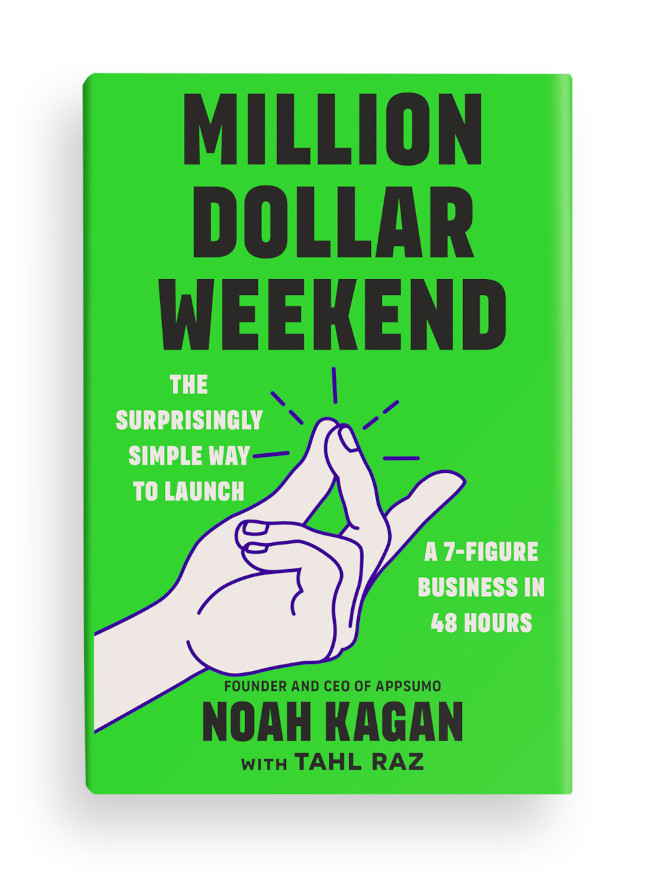
Or grab the whole thing: Million Dollar Weekend
Stop asking if they’d buy. Send the payment link today.
Start a business in 48 hours.
Million Dollar Weekend is the process I used for eight businesses, written down. #1 on Amazon and Audible.
Read the first chapter free
Leave a Reply